Tree trimming does not start with a saw. It starts with timing.
Most homeowners look at a tree and think in simple terms. Does it look too big. Is it hanging over the roof. Did a branch crack last week. Those are fair questions. They matter. Still, the season matters too. Trim at the right time and the tree recovers well. Trim at the wrong time and the work can stress the tree, leave weak cuts, or push new growth at the wrong point in the year.
In Indiana, the best time to trim many trees falls between late winter and early spring. That window lines up with dormancy for a lot of common species. Growth has slowed. Leaves are gone on many deciduous trees. The branch structure is easier to read. Crews can spot deadwood, crossing limbs, weak unions, and bad weight distribution with less guesswork.
That timing works well for homeowners too. March and early April often bring the first real push into yard work across Indianapolis, Carmel, Fishers, Noblesville, and Westfield. People look up, see overhanging limbs, and realize the tree they ignored all winter is still very much there. Just larger. Just closer to the roof. Just one hard spring storm away from becoming a much more expensive problem.
So when should you trim your trees in Indiana? For many properties, early spring is the sweet spot. Not every tree follows the same calendar. Not every yard has the same risks. Still, for routine pruning, this is the season that makes the most sense.
Why timing changes the result
Tree trimming is not random maintenance. It is planned care. The tree reacts to every cut. That reaction shifts with the season.
During dormancy, a tree is at rest. It is not pushing leaf growth. It is not spending energy on rapid new shoots. That gives the tree a cleaner window for pruning. Once warmer weather settles in, healing begins and new growth can form from a stronger structure.
Early spring gives crews a better view too. Fewer leaves mean fewer hidden defects. It is easier to see the shape of the canopy. It is easier to spot branches that rub, branches that grow inward, and limbs that carry too much weight at poor angles.
There is a second reason timing matters in Indiana. Spring storms hit hard. Wind, heavy rain, saturated soil, and late ice events can all push weak trees past their limit. A tree with deadwood or unbalanced limbs is already behind. Pruning before the storm season starts gives that tree a better chance to hold up under pressure.
A lot of storm calls begin with the same sentence. We knew that branch looked bad. That sentence is honest. It just usually arrives a little late.
What early spring pruning does for your trees
Good pruning does three jobs at once. It supports tree health. It reduces risk. It improves shape.
Start with health. Dead limbs do not recover. Diseased branches rarely fix themselves. Crossing branches rub bark away and create open wounds. A crowded canopy traps moisture and limits airflow. All of that adds stress. Pruning removes part of that stress and gives the tree a cleaner structure.
Then there is risk. A heavy branch over a roof is not just ugly. It is a hazard. A split limb over a driveway is not waiting for a polite moment to fall. It will drop when weather, weight, or decay finally wins. Removing those problem limbs in spring can cut the chance of damage later in the year.
Shape matters too. Trees grow with patterns, but those patterns are not always helpful on a residential lot. Some trees push weight toward a home. Some grow low over sidewalks. Some block half the yard from sunlight. A skilled pruning job keeps the natural form of the tree but corrects the parts that create stress or danger.
That is the real value of spring trimming. You are not hacking a tree back. You are setting it up for a better growing season.
Which trees in Indiana often benefit from spring trimming
A lot of common Indiana trees respond well to pruning in late winter or early spring. Maples, ash, elm, hickory, and many ornamental trees often fit this pattern. Property owners across Indianapolis neighborhoods see these species every day, so the timing matters in a practical way, not just in a textbook way.
Oak trees deserve a quick note. Oaks often need more care around pruning timing and wound exposure. Local conditions matter. The exact timing can shift with species and risk. That is one reason a site visit helps. A crew can look at the tree, the age, the health, and the placement on the lot, then decide if spring is right or if a different window makes more sense.
Fruit trees are their own category. A lot of homeowners want stronger structure and better production from apples, pears, and similar trees. Early spring pruning often plays a big role there too. The cuts need purpose. Random cuts waste the season.
Palm trees are not the local story here, so you will not see much of that in central Indiana. Shade trees, ornamentals, mature yard trees, and storm-prone limbs are the real spring focus for this market.
Signs your tree is asking for help
Trees do not send a text. They do give signs.
Dead branches are the clearest signal. If a limb has no life in it, the tree has already made the decision. The branch just has not fallen yet. Broken limbs matter too. A branch that cracked in winter can hang in place for weeks, then drop after one wet afternoon.
Look for branches over the roofline. Look for limbs brushing gutters. Look for low limbs over driveways or sidewalks. Look for dense areas in the canopy that seem to swallow light. Look for branches that cross and rub. Look for weak branch unions that form a narrow V shape and carry too much weight.
Take one step back from the tree and check the whole form. Does one side look heavier. Does the crown lean toward the house. Does the tree block all the light from the lawn or patio. Does it look crowded compared with the rest of the yard.
Those signs do not always mean removal. A lot of the time they point to pruning. The key is acting before the branch acts first.
Why storm season makes spring trimming more urgent
Indiana spring weather has a mean streak. One day feels like yard work weather. Two days later you have 45 mile per hour wind gusts and sheets of rain.
Storm damage rarely comes out of nowhere. The weather is the trigger, but the weakness was often there already. Dead limbs, poor weight balance, long overextended branches, and old cracks in branch unions all make storm failure more likely.
Spring pruning reduces that risk in a direct way. Crews can remove deadwood. They can shorten overextended limbs. They can thin crowded areas that catch wind. They can cut back branches that hang over structures. Each one of those steps lowers the odds that your next storm turns into an emergency call.
That matters in practical terms. Emergency removal costs more. Emergency conditions are riskier. Access is harder. Weather is worse. The tree is less stable. If routine pruning in March removes the branch that would have hit your roof in May, that is not a small win. That is the whole point.
Can you trim a tree yourself
Some homeowners can handle very light pruning on small trees. That is true. A hand pruner and a reachable branch are one thing. A mature tree over a roof is a very different thing.
Ladders, chainsaws, and overhead limbs are a rough combination. The branch weight shifts. The ladder moves. The cut binds. The limb swings in a way the person on the ground did not expect. That is how a quick Saturday job turns into an ambulance call or a crushed gutter line.
There is a second issue. Bad cuts hurt trees. Flush cuts, topping, random branch removal, and heavy over-pruning can all leave a tree weaker than before. Once a canopy is cut badly, the tree often answers with unstable new growth and poor structure. Then the next trimming job gets even harder.
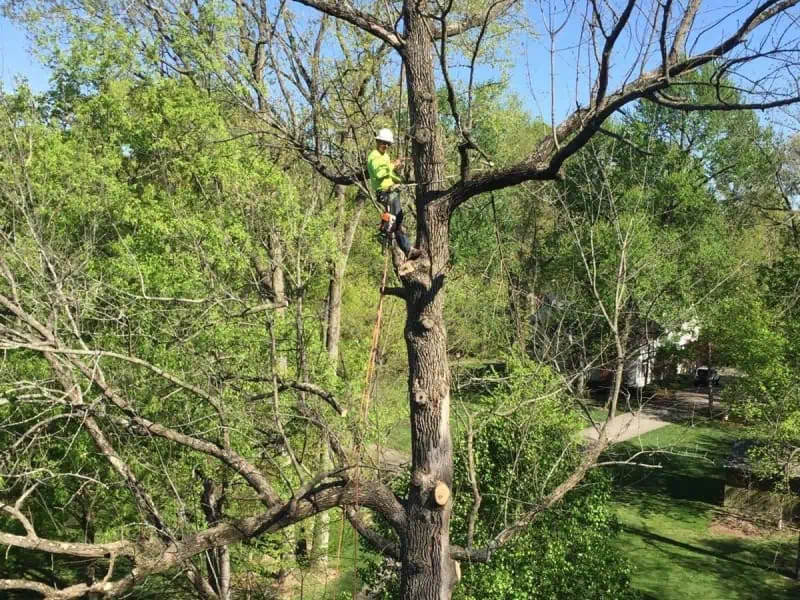
A trained crew does not just cut. They read the tree first. They look at limb weight, branch angle, tree health, access points, drop zones, and nearby structures. They bring climbing gear, rigging, saws, trucks, and cleanup tools built for the work.
That level of planning matters more than people think.
What a professional trimming visit usually looks like
A solid trimming job starts with an inspection. The crew walks the property. They look at species, condition, and structure. They ask what the homeowner wants fixed. Roof clearance. Better light. Storm prep. Safer access near the driveway. A cleaner shape. Those details guide the work.
Then the plan gets specific. Which limbs come off. Which branches stay. Where will debris go. What equipment is needed. Is this a climbing job. Is a bucket truck the safer call. Are there utility lines or tight access points to work around.
During the work, the goal is clean cuts and controlled movement. Branches are removed in a way that protects the tree and the property. After that comes cleanup. Chips, brush, and cut limbs leave with the crew unless the homeowner wants mulch left on site.
That cleanup matters. People remember it. They remember the tree, but they also remember whether the yard looked like a work zone for three more days.
Why this matters for Indianapolis homeowners right now
This topic is timely in March for a reason. Trees in the Indianapolis area are about to shift into active growth. The storm season is close. Homeowners are already outside again, which means they are seeing winter damage, crowded canopies, roof clearance issues, and overdue maintenance.
This is the moment to act on those problems. Not in the middle of a thunderstorm. Not after a branch tears down the gutter. Not when the driveway is blocked.
Early spring trimming gives homeowners a cleaner window. The tree is easier to inspect. The work is more controlled. The results carry into the rest of the year.
If a tree on your property looks heavy, crowded, damaged, or too close to the house, now is the time to deal with it. The season is right. The risk is clear. And the fix is usually simpler before the weather gets loud.
